How to Prepare Your Data Room for Legal Due Diligence
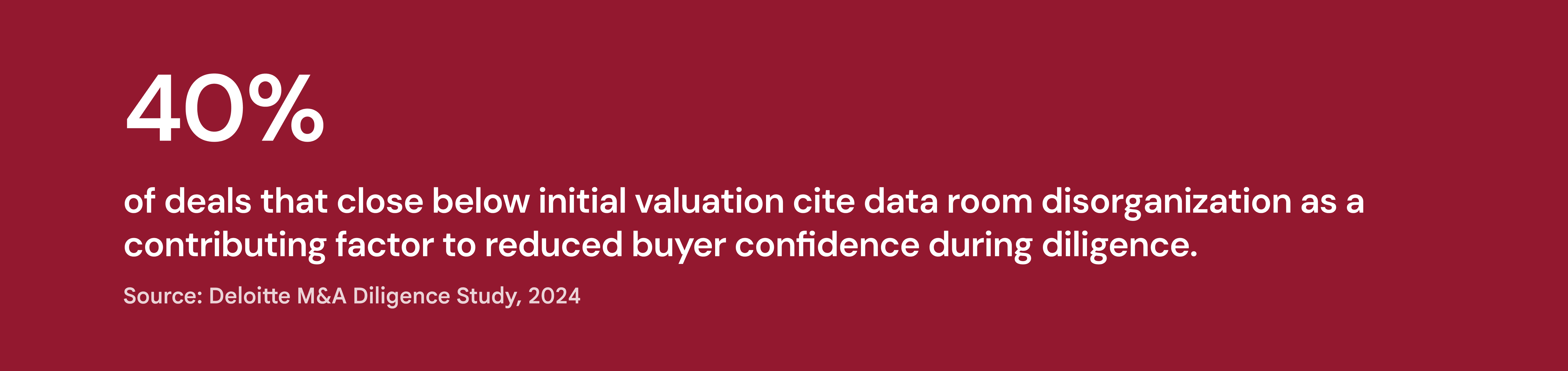
A data room is not a filing system. It is the first impression an investor or acquirer has of how the company is managed. When it is disorganized, incomplete, or contradictory, the problem is not just administrative inconvenience. It signals that the company does not have a clear picture of its own legal position.
That signal is difficult to walk back. Diligence teams are experienced at reading disorders. And once they start asking follow-up questions driven by uncertainty rather than genuine risk, the process expands in ways that are hard to control.
What a Well-Prepared Data Room Communicates
A well-structured data room does something more than provide information. It demonstrates that the company is in control of its legal and operational position. Documents are current. Decisions have rationale. Deviations from standard terms are acknowledged and explained rather than buried.
That demonstration of control builds investor confidence faster than any individual document can. It shifts the conversation from investigation to confirmation.
Structure: What Goes Where
Corporate documents: Certificate of incorporation, shareholder register, board resolutions, all equity documentation. These should be organized chronologically and complete. Gaps in board minutes or unresolved equity instruments will trigger immediate follow-up.
Commercial contracts: Customer agreements organized by tier or revenue contribution, vendor agreements, partnership terms. Where standard templates were used, that should be clear. Where deviations were made, they should be accompanied by a brief note on the rationale.
Regulatory and compliance: Any regulatory analysis, license applications or approvals, data processing agreements, privacy documentation. For regulated sectors, this section will receive disproportionate attention.
Intellectual property: Invention assignments, trademark registrations, any third-party IP licenses that the product depends on. The question investors are asking here is whether the company cleanly owns what it sells.
Employment and HR: Offer letters, confidentiality agreements, equity documentation for current and former team members. Any departures that involved negotiated settlements should be documented.
The Most Common Data Room Mistakes
Uploading unsigned versions of contracts. It sounds obvious but it happens frequently. An unsigned agreement is not an executed agreement and investors will notice.
Including outdated documents without flagging them. If a document has been superseded, that should be noted rather than leaving the diligence team to figure out which version governs.
Missing the narrative thread. Documents alone do not tell a story. For key decisions, a regulatory interpretation, a deviation from standard contract terms, a specific risk the company accepted there should be a brief accompanying note that explains the context.
The best data rooms are not assembled in the three weeks before a process launches. They are maintained continuously so that producing them requires organization rather than reconstruction.
Lexapar supports this by keeping legal documentation centralized, preserving the reasoning behind decisions as they are made, and flagging deviations that will need explanation when the time comes. When diligence begins, the response is retrieval, not scrambling.
Build a data room that works for you, not against you
Lexapar keeps your legal documentation centralized and decision rationale preserved so diligence becomes confirmation, not investigation.
