When Should a Startup Move From External Counsel to Legal Infrastructure?
External legal counsel is the right answer for early-stage companies. A trusted law firm handles the questions that need specialist judgment, and the founder moves on. The cost is high but the volume is low, so the model works.
At some point, it stops working. The trigger is not a specific headcount or funding milestone. It is a pattern: legal is becoming a bottleneck, costs are unpredictable, and the same issues are being re-examined from scratch every time they arise. When that pattern becomes consistent, the problem is not the lawyers. It is the infrastructure around them.
What External Counsel Cannot Do
Law firms provide advice. They do not provide institutional continuity. Every engagement starts with context-setting. Every new matter requires explaining the company's history, structure, and previous decisions. When the same firm handles multiple matters over time, some continuity develops within individual partners. But that continuity is personal, not systemic, and it leaves with them when the relationship changes.
External counsel also cannot create the internal accountability structures that investors and enterprise buyers expect. A legal opinion from a respected firm is valuable. It does not substitute for documented internal decision-making, standardized contract positions, or a retrievable record of how legal risks have been assessed and approved.
The Signs That the Transition Is Overdue
Contract reviews are creating commercial delays. When legal review consistently holds up deal closure, the issue is usually not complexity it is the absence of pre-defined positions that would allow straightforward contracts to move without full review.
The same legal questions keep getting asked from scratch. Regulatory interpretation, liability cap rationale, data protection position. If these are being re-analyzed each time rather than retrieved from documented institutional knowledge, legal capacity is being consumed inefficiently.
Diligence processes feel like reconstruction. When an investor or acquirer asks how a decision was made, and the answer requires finding the relevant email thread from 18 months ago, the company is operating without institutional legal memory.
Legal costs spike without a corresponding increase in complexity. Reactive legal engagement at premium rates is expensive by design. It is also a symptom of the absence of structure, not the cause of it.
What the Transition Actually Involves
The shift to legal infrastructure is not about replacing lawyers with technology. It is about building the operational layer that makes external counsel more efficient when they are needed and less necessary for routine decisions.
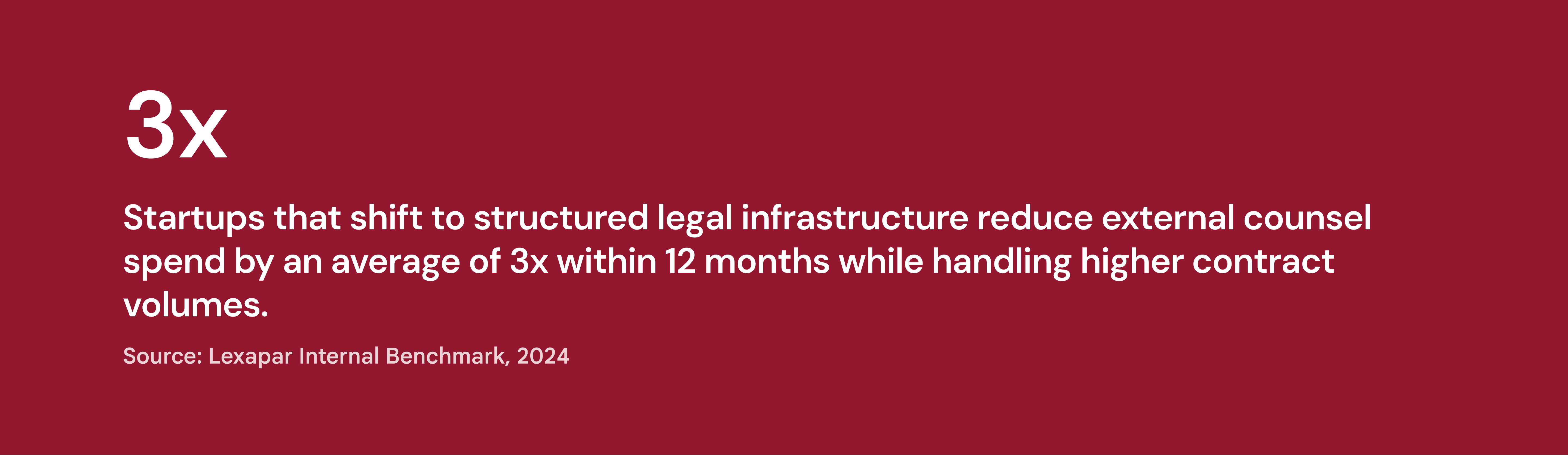
That means standardized contract positions with defined deviation thresholds, documented approval workflows, centralized legal decision history, and continuous obligation tracking. These systems are what allow a company to scale commercial volume without proportional growth in legal cost.
Lexapar is designed specifically for this transition point. It gives growing companies the internal legal operating layer that transforms external counsel from a day-to-day dependency into a high-value specialist resource for genuinely complex questions.
Make the transition from reactive counsel to structured infrastructure
Lexapar builds the internal layer that makes your legal function predictable, scalable, and diligence-ready.
